

Tomatoes!


Fruit!


Cucumbers, squash, and eggplant!


Corn!


Flowers!


Mt. Shasta Farmers’ Market

Cheers!
Tomatoes!
Fruit!
Cucumbers, squash, and eggplant!
Corn!
Flowers!
Mt. Shasta Farmers’ Market
Cheers!
 Pickle prep

Eggplant, tomato, lettuce, onion sandwich on Dutch crunch roll


Spiralized zucchini lasagna

Grandma’s Eggplant parmesana

Gretta’s tomato, sausage, pepper, basil, mushroom flan

Curried Mtn. View potato, zucchini, onion, tomato, Hunter’s garlic, Charlie’s smoked tri tip, with rice

Gretta and Charlie’s stuffed eggplant and zucchini

Rockside Ranch Italian sausage, Mtn View onions, squash, tomatoes, with pasta and parmesan

Omi’s Pflaumenkuchen with Marjie’s plums
In recent years there has been a movement back to sustainable and organic management of crops and land. This has been forced due to the continued development of industrialized agriculture since the turn of the 20th century, which applies destructive methods of chemical agriculture and genetic engineering. This mismanagement has been pushed to the limit for the most convenient production and profit churned out over large scale monocultures degrading the natural environment and enslaving farm workers into an eternal cycle of debt. This calls for a need to return to organic practices to maintain an equilibrium with our surrounding environment through a healthy relationship with our plants, animals and fellow humans that can perpetuate for generations to come.
Navdanya, or the ‘nine seeds’ research program in India is a spearhead against industrialized agriculture and Monsanto’s attempt at dominance over Indian farmers. Their efforts have helped set up seed banks across India to make available alternatives to chemical and genetic agriculture as well as educate about sustainable farming practices. This has reduced poverty and saved the lives of many farmers who were taking their lives as a result of the lifetime debt incurred upon them by Monsanto. Navdanya offers a counter movement to Monsanto by offering organic fair trade seed domestically and internationally, combatting the encroachment of monoculture worldwide. “Navdanya has connected biodiversity conservation with organic production and have challenged the standardization, uniformity and lack of quality, promoted by the industrial food system,” (Shiva). This has allowed for the free flowing of organic farming and produce to return to India as a sustainable non-violent practice, re-fostering life and biodiversity to a land deprived by monoculture.
Biodiversity is essential because it allows for a reciprocal relationship between plants and soil to develop between seasons and generate ideal growing conditions for crops. As pointed out by Vandana Shiva in Monocultures of the Mind, “Sustainability and diversity are ecologically linked because diversity offers the multiplicity of interactions which can heal ecological disturbance to any part of the system. Nonsustainability and uniformity means that a disturbance to one part is translated into a disturbance to all other parts,” (Shiva). When a natural environment is allowed to operate under the order of the universe, varieties of crops will be created, generating tolerance to disease and pests that threaten their vitality.
These same threats attack monocultures who use chemicals to combat hostilities rather than allowing the plants and their natural environments to defend themselves. If one of these chemicals were to fail, or the disease or pest develop resistance to the spray, a monoculture could be completely wiped out causing whole crops to fail. These problems are what plagued the Indian farmers who had fallen prey to Monsanto’s propagation of engineered seed. Many of their crops were failing due to widespread monocultures not having the ability to defend against the planet’s natural inhibitors. Here the need for biodiversity is crystal clear because without an ecosystem to support life on many levels, including soil microbes and beneficial insects the crops must be maintained through an artificial means.
To grow biodiverse crops, one must have access to a variety of seeds. This is the primary mission of Navdanya. “Through Navdanya, a national network for setting up community seed banks to protect indigenous seed diversity, we have tried to build an alternative to the engineering view of life.… we have tried to build an alternative to the paradigm of knowledge and life itself as private property,” (Shiva). It is a crime to place ownership over life, and that is exactly what Monsanto has done through patenting and gaining complete ownership over certain varieties of engineered seed which has extinguished many of the natural varieties that used to be available to farmers. By setting up seed banks across India Navdanya has saved the organic varieties and made them accessible to all for use in biodiverse agricultural communities. Navdanya has a mission to protect the many varieties of seed and life on Earth. Patenting seed prevents or stops the natural cycle of seed reproduction and adaptation to its current environmental conditions. Creating an environment of compatibility between people, the Earth, food and the seed from which our food is grown will foster harmony and sustainability into the future.
The act of farming is very rooted in the natural processes of the Earth. A connection is gained when the plant has access to its natural environment, is being fed the tea and the proper fertilizer that nourishes its growth and leads to the enhancement of the food it produces. In an interview for the Huffington Post, Shiva expresses that “The simple act of sowing a seed, saving a seed, planting a seed, harvesting a crop for a seed is bringing back this memory – this timeless memory of our oneness with the Earth and the creative universe,” (Gelder).
This is our call, our return to the organic and sustainable practices of our ancestors which we have lost through industrialization. It takes a mindful approach to the complexity of life and how it interworks to support itself through a constant process of self-organization, and use that intelligence to maintain a biodiverse and sustainable way of life into the future.
Works Cited
Gelder, Sarah Van. “Vandana Shiva On Seed Saving and The Fight For Biodiversity.”
HuffingtonPost.com. N.p., n.d. Web. 31 Aug. 2016.
Shiva, Vandana. Biopiracy: The Plunder of Nature and Knowledge. Boston, MA: South End,
1997. Print.
Shiva, Vandana, Dr. “Organic Production.” Navdanya.org. N.p., n.d. Web. 31 Aug. 2016.
Shiva, Vandana. Monocultures of the Mind: Perspectives on Biodiversity and Biotechnology.
London, UK: Zed, 1993. Print.
 This white ringmaster onion made it up to the saddle of Mt. Shasta at Sisson Lake. Mt. Shasta peaks in background. I felt it deserved a post of its own!


Olivia came to visit us with Daphne and Mike! She is like a ray of sunshine!


Prepping onions for market with help from Noelle, Jonny, and Deanna


Deanna knows how to cook Italiano style!

Deanna, Ute, Skye, Jonny, Sean at Dunsmuir City Park in August (with Noelle)


Views through time of the fields from the front porch


It appears as though we will have three rounds of melon harvest this season. We have had a go round with cutworm damage to the first and second plantings. The third and final planting will have individual cardboard collars around each plant to create a barrier. We did have some melons survive from the first and second plantings. Pictured above are caribbean gold, papaya dew and watermelon.


Tomatoes will come in many varieties, with midseason reds and large heirlooms!


Corn fields are thriving! This mosaic shows growth through time.


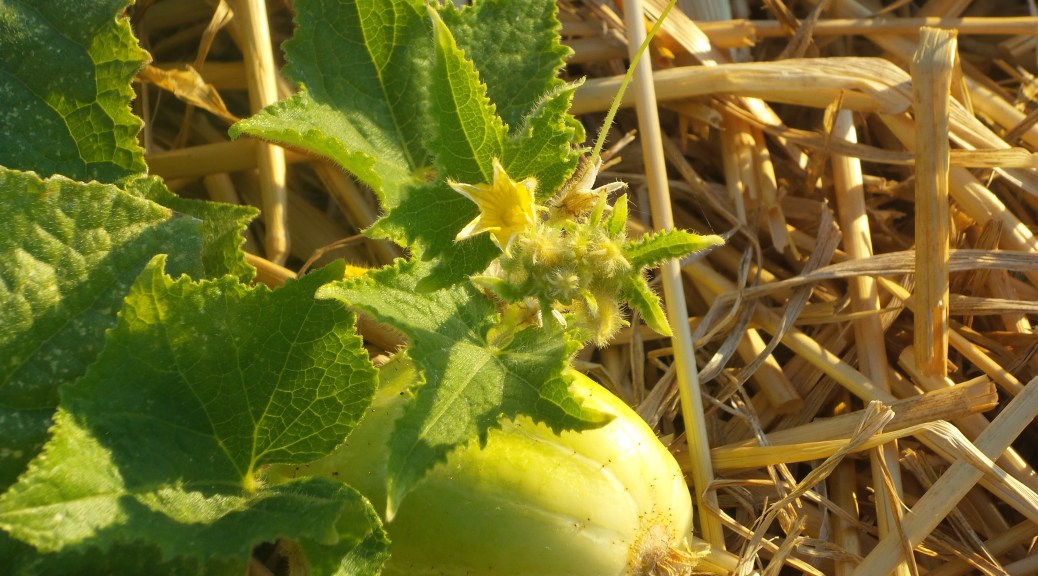
Cucumbers are starting to run and flower! After a few rounds of hoeing weeds, we spread a nice thick bed of straw around them to conserve water, keep a soft top layer of soil, and have a clean bed for them to lie on as they grow.

Lots of onion varieties and leeks this season!


Showing progression backwards in time. We will have summer squash and zucchini for our first market on July 11th!


We found it to work out better when the four of us work as a team to lay the straw, rather than using the straw blower. This way, it is placed more strategically and is more gentle to the plants.

Strong stand of purple and white eggplant!


POTATOES!!!
Yukon Gold, Russet Burbank, and Purple Viking potatoes have been hilled, and mulched heavily with organic aged bark and straw. They just keep on growing taller, so we will be putting on another layer of straw soon. This could mean lots of taters!


Sean on top of straw bales, Omi and Opi with first harvest share, and Mt. Shasta!
We are blessed to have this beautiful view of the mountain. That’s why we are
Mountain View Organics!!!
2016 marks the beginning of our fourteenth season of farming Mountain View Organics. The fields are disked and cover cropped, which brought us some beautiful visitors to the open fields. The cranes pictured below faithfully landed on the seeded fields each morning until the seeds germinated. I see these same birds down the road a piece on another open seeded field. These cranes are a rare sight around here and are welcome. We do not mind sharing a few seeds with them for the tranquility and beauty they provide.


Skye is driving the John Deere up the freshly graveled drive after disking the fields. No rototilling this season, simply disk and drag prior to opening up furrows for planting with a triangular blade.


Record rainfall this winter brought a multitude of blossoms on our fruit trees. Pictured from left to right are nectarine, apricot, and cherry blossoms.


Flats of transplant containers filled with vitality for a healthy start. We watch the biodynamic calendar for optimum planting dates for the various crops.


A variety of tomatoes from paste to large red heirlooms were started in flats, then transplanted to 6-packs, and later to 3″ and 4″ pots for momentum and prime readiness for transplanting in May.


Red and green cabbage show steady growth.


Greens, including various lettuces, kale, and mustard will be planted this weekend, along with onions, potatoes, broccoli, and cabbage!


Seedlings of watermelon, various muskmelons, and cucumbers show a healthy germination rate.

Who says that corn can’t be transplanted??? We do it!

This is why we’re called Mountain View Organics!
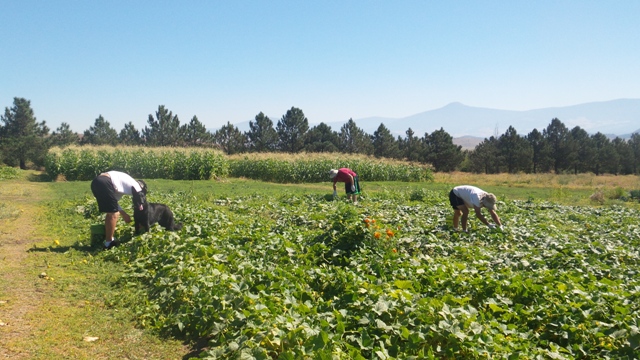 Harvesting cucumbers…
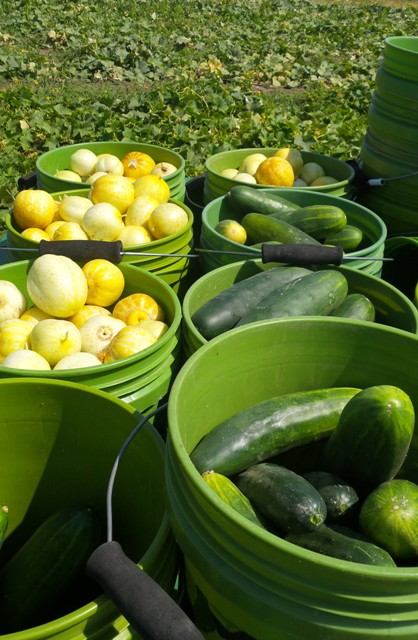
Bucket-fulls of cucumbers…
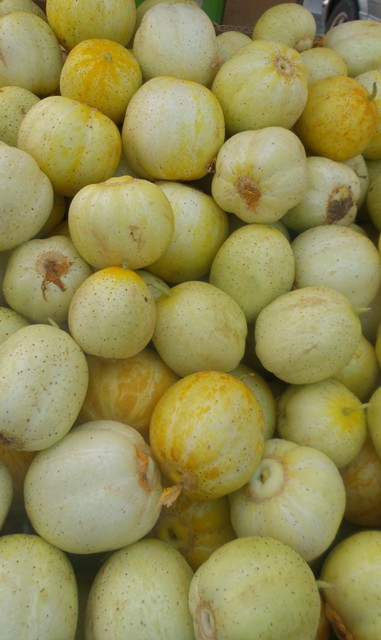
Lemon cucumbers
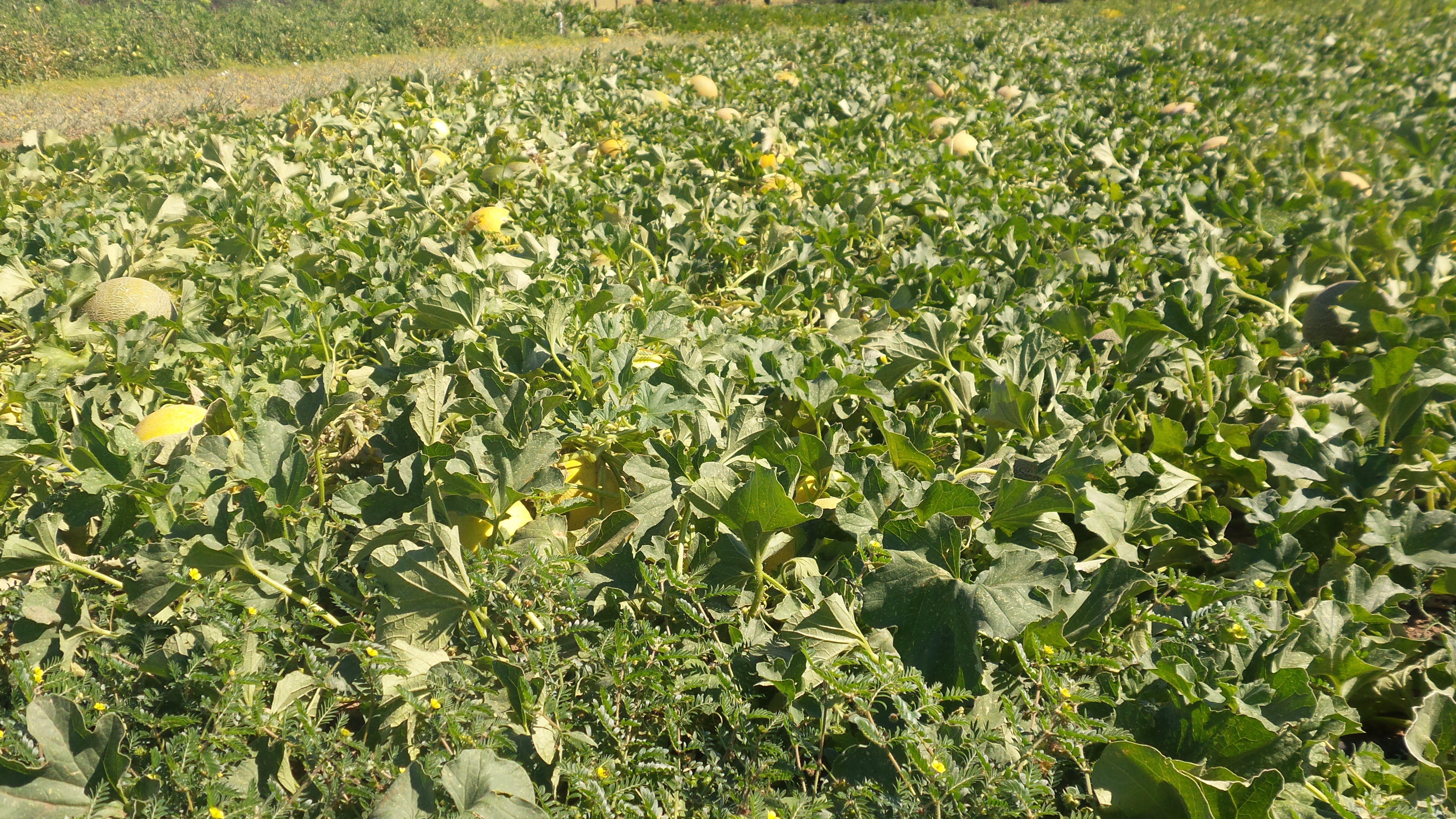 Galia melons are the best!
 Melon display at the Mt. Shasta Farmers’ Market
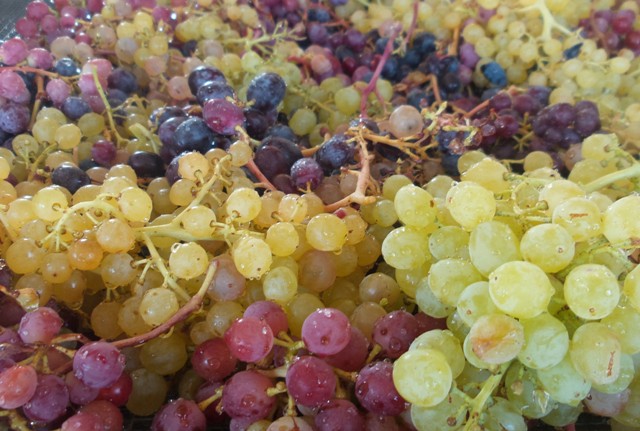 Various seedless grapes! We’re making raisins…
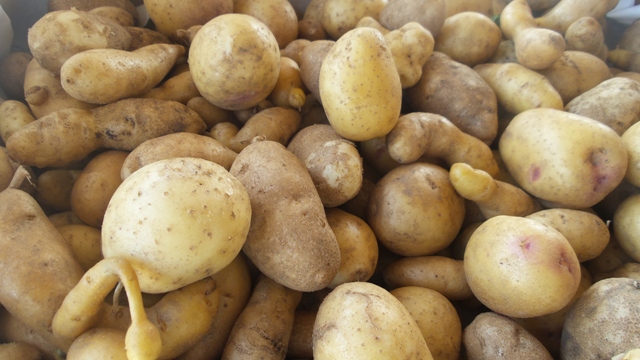 Potato harvest for the family
 Buckets of onions in from the field
 Red Torpedo and Red Defender
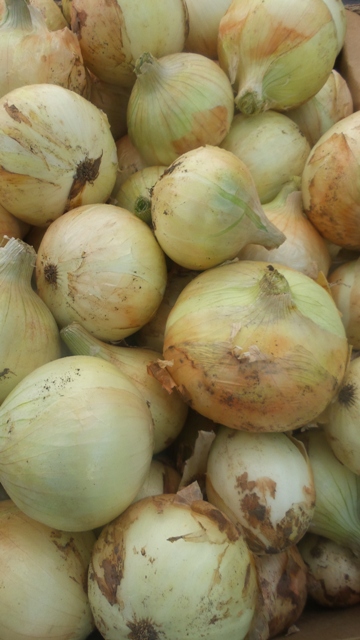 Walla Walla
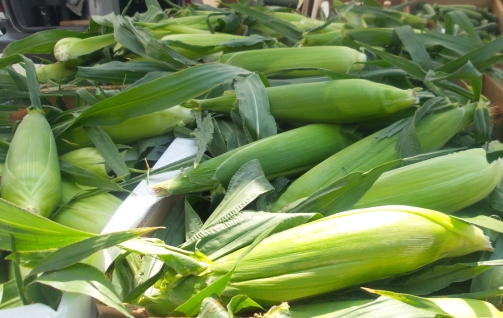
Silver Queen Corn

Displays loaded and ready for market!
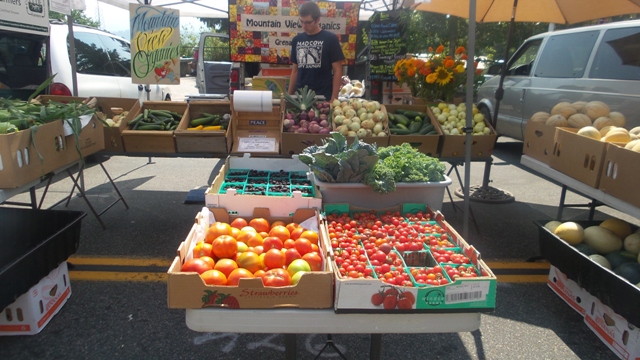
Thank you to the good people of Mt. Shasta! We are glad you like our food!!!
 Gopher snake! A good guy in the garden…they help to keep the rodent population in check. It is, however, startling when bending down to harvest a beautiful zucchini, to find that diamond pattern with the same coloration as the deadly rattlesnake right at one’s fingertips! Look for the rattle…also the head is shaped slightly different, with the rattlesnake having more of a triangular head.


Cucumbers are reaching out, flowering, and producing fruit! Painted serpent, or striped Armenian cucumber
 Walla Walla onions bulbing up nicely!
 The tall proud red guy is the rooster…he’s a nice one! The hens are quite happy!
 Baby chick born…mama hen keeps watch!
 Tomatoes are forming and hanging on the vines!
 Black widow…what a beautiful spot for your web…you carry a deadly venom, but when you look so healthy and nurturing towards your young, it is tough to kill you…just don’t come into the house and you will survive!
 Blackberries starting to develop a little color…
 Melon field
 Melons growing…hope to have some for market soon!
 Omi and Opi are happy with this early harvest share!
 Jordan and Sean prepping 2nd field of summer squash
 Lots of hula hoeing!
 Skye shot a rabbit…sad to take its life, but when this beautiful creature methodically eats all that we have grown, there isn’t much choice…
 View of Mt. Shasta from Mountain View Organics
 Halona melons are usually the first to harvest, but we have had nightly visitations out in the melon fields. At first, the foliage was being eaten. Next, when the melons started forming, they were munched by some critters, which we correctly guessed were rabbits. Here we have EVIDENCE!!! They have been caught in the act on our Bushnell night vision motion sensor camera!!! A glowing eye can be seen on the right side of the picture…
 Now we see two eyes…
 Long ears…we see you!
 Good…eat from that melon pile…instead of taking a fresh bite out of each and every melon.
 Clearly…you are a rabbit!
 Yeah…you! We have EVIDENCE!!! These after-midnight parties have got to end!


 Mountain View Organics